Toward huemul restoration: a paradigm shift in Patagonian conservation
With most of the country’s huemul deer surviving in Santa Cruz, a binational workshop in Chile opened an urgent debate: moving away from protecting precarious refuges and toward restoring populations in optimal habitats. “It’s not enough to protect the 1% that remains,” warned Sebastián Di Martino.
The huemul has lost 99% of its original population, and today barely 500 individuals survive in Argentina and around 1,000 in Chile. According to the biologist and Conservation Director at Rewilding Argentina, Sebastián Di Martino, the situation “is critical,” but the focus now is that “we are mostly conserving the huemul in places where it lives as a refugee, after having been pushed out of better habitats. These are high mountain areas, with long winters, little vegetation, and animals with nutritional problems,” he explained.
Generally, when we think of the huemul, we picture a deer standing still among trees, almost invisible in the dense mountain forest… but that image, so deeply rooted in Patagonian memory, would not be the full picture.
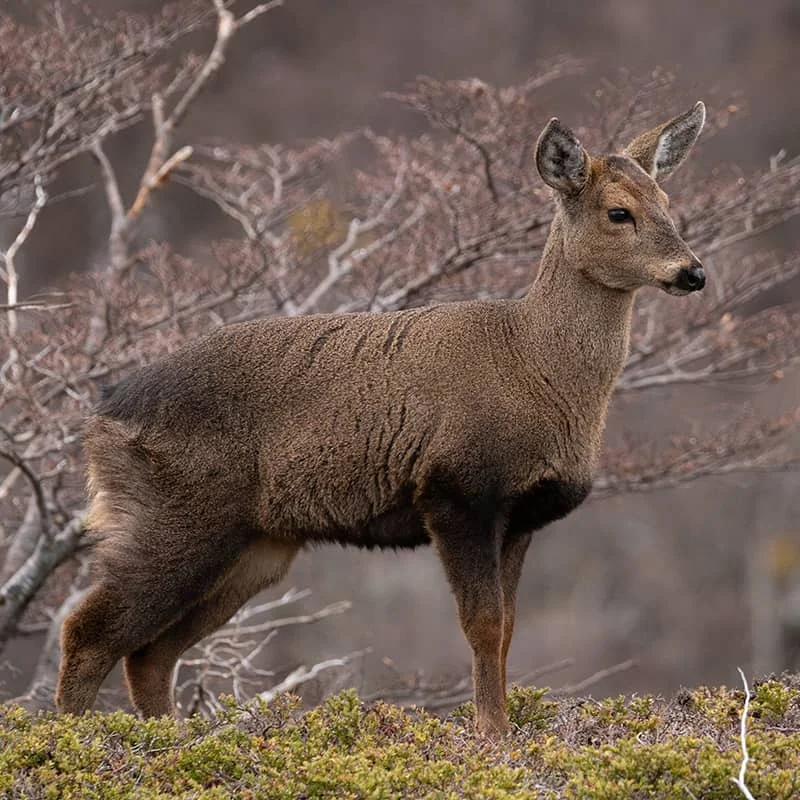
Di Martino cites research by Werner Flueck, a CONICET researcher, that reveals the fragility of these populations. “Deformed antlers, premature tooth loss, and a lifespan sometimes reduced to less than five years, when the species should reach at least twenty.” Another relevant finding is that “the loss of migratory behavior is being detected.” The huemul stays in the mountains all winter, under one or two meters of snow, without descending to the valleys where there is better grazing, “and it doesn’t do so because many of those valleys are now occupied by towns, livestock, or dogs.”
The binational workshop in Chile focused on huemul recovery and brought together researchers, authorities, and organizations from both countries. Over two days, scientific evidence, reintroduction experiences, and the urgency of a cultural shift in conservation were put on the table. “Until now, the conversation was about protecting what little remains; today the debate is shifting toward how to restore what has been lost,” Di Martino explained, highlighting the value of having shared perspectives and commitments among the region’s different stakeholders.
The meeting brought together representatives from Argentina’s National Parks Administration, as well as government and organizations from provinces such as Neuquén and Chubut, from the Chilean government including the National Forestry Corporation (CONAF) and the Agriculture and Livestock Service (SAG), plus foundations and NGOs such as Rewilding Chile, WCS, and Huilo Huilo, the latter hosting the event. Researchers involved in breeding and reintroduction projects in the region also took part.
New tools and experiences
This shift in approach puts the restoration of populations in environments considered primary for the species on the table: lower-elevation areas, with open vegetation, wetlands that provide abundant quality forage, and milder climates. One of the conclusions of the meeting is that this is where huemul reintroduction efforts should be focused – environments like those preserved today in Patagonia Park, in Santa Cruz, where the huemul once lived and was a common presence, as evidenced by explorers’ accounts and old antlers still kept by some local residents.
This shift also comes with growing validation of breeding and reintroduction centers. For years, many sectors resisted the idea of keeping and releasing huemul bred in captivity. Today, the examples of Huilo Huilo in Chile and Shoonem in Chubut, Argentina, show encouraging results.
The recent case of a young male born into the reintroduced population at Huilo Huilo, which crossed the mountain range and entered Lanín National Park, showed the potential of these initiatives. Huemul had not been recorded in Lanín National Park since 1990.
“The Huilo Huilo example swept away many preconceptions. They already have animals born at the center that have reproduced in the wild. And they have released several individuals in places where the huemul had disappeared. That shows it’s a useful tool, and one that will be used more and more,” he noted. “These tools can also be used in Santa Cruz,” he emphasized.
The huemul and ecosystem balance
Beyond its symbolic value, huemul restoration responds to ecological reasons. “It is one of the large herbivores that once inhabited all of Patagonia and plays key roles in the ecosystem,” Di Martino explained. In fact, a recent international study included it among the twenty priority species for recovery worldwide to help heal ecosystems.
The underlying view is that it is not enough to preserve just 1% of what the species once was. “The huemul is the most endangered deer on the American continent. Neither the polar bear nor any other large mammal on the continent is in a more critical situation. That’s why we have to restore – we can’t settle for what’s left.”