When Nature Begins to Recover in Patagonia
The story of Sofía Ocampo, a veterinarian working on the conservation team at Parque Patagonia, shows how efforts are made to restore native species, rehabilitate ecosystems, and reconnect with our shared home.
In the northwest of Santa Cruz, where the wind is an ever-present companion across the steppe, work happens every day—often unnoticed. This is the work of teams who monitor, relocate, care for, and accompany long-term processes, guided by the conviction that what has been damaged can be repaired.
In this network of efforts stands Sofía Ocampo, a veterinarian at Parque Patagonia, who found in rewilding a tangible way to give back nature its own rhythm and gradually rebuild the balance that sustains life.
Her journey began far away from the steppe. During her years studying at the Universidad Nacional de La Rioja, a specific experience marked a turning point.
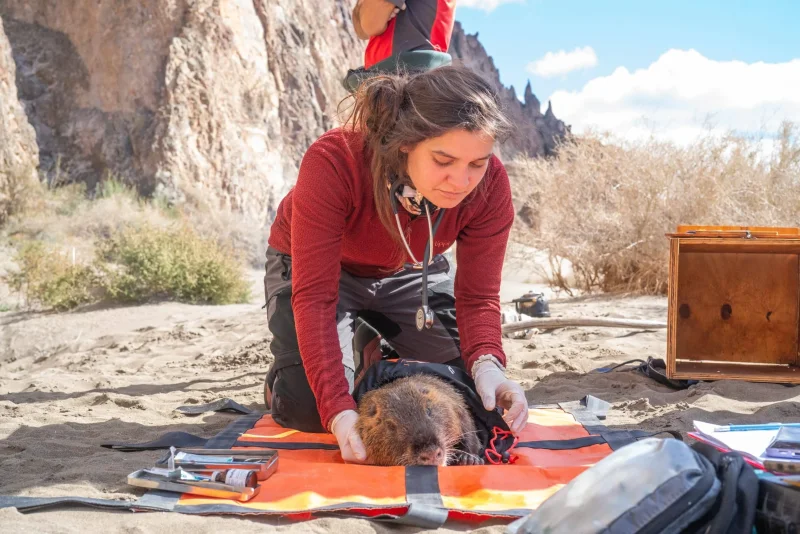
Sofía recalls that everything changed for her when a puma hit by a car arrived at the hospital where she was doing her internship. She was involved in its treatment and recovery, and on the way realized something deeper: “We were treating an animal, but we were also helping the ecosystem.”
That idea began to take root. Volunteer experiences came next, followed by initial contacts with conservation, and eventually, rewilding as a tangible way to get involved.
The Value of What Cannot Be Seen
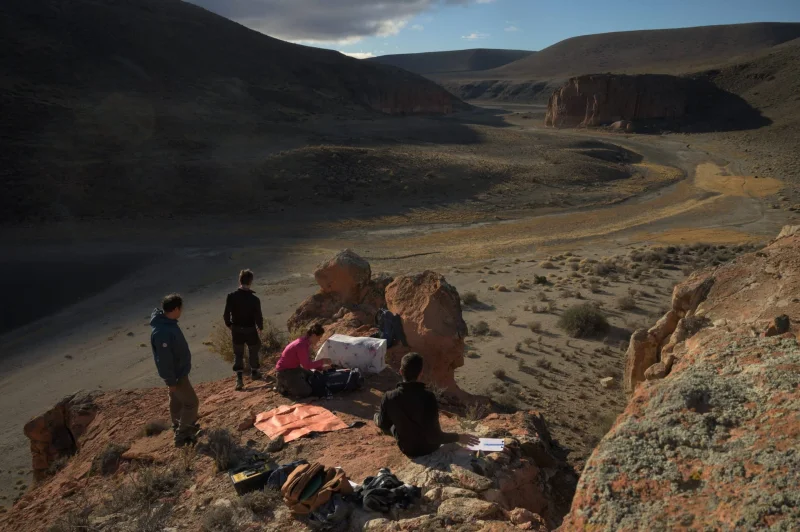
Working at Parque Patagonia is also a sensory experience. “There’s something very special about the vastness of the steppe. Wherever you stand, you see everything; there’s no end to the landscape,” Sofía describes. Added to that is the constant presence of wildlife, which she considers part of the daily driving force.
There’s one more thing, hard to understand until you experience it. “That’s when I discovered what true silence is,” she says. That landscape, together with a team that shares convictions, gives full meaning to a job that, as she explains, “is incredibly intense but also incredibly profound.”
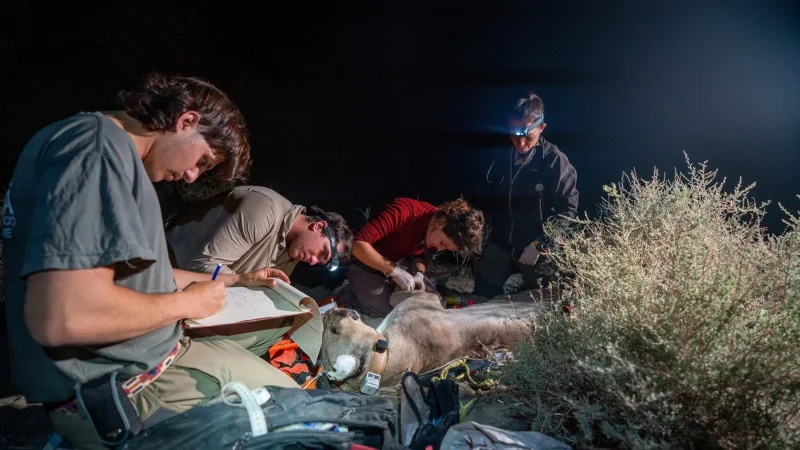
Her daily work constantly changes. It can include planning captures, monitoring species, administering anesthesia, translocations, following up in the wild, or quarantine tasks.
“Nothing is predictable,” Sofía summarizes when talking about working with wildlife. And that statement captures much of the challenge: “You have to be prepared, flexible, and constantly adapt to the species, the moment, and the particular individual,” she explains
Added to that is the context. “The weather, the wind, the distances are extreme,” she says, also noting the logistical complexity of a place where “we live quite isolated.” All of this is part of work that is constantly changing and requires continuous dynamism.
Among so many experiences, one in particular stands out for her. “I think it was the translocation of Darwin’s rheas between Argentina and Chile,” she recalls. The process included capture, quarantine, and relocation with complex logistics, but it also had a particular significance: “It was the first wild-to-wild translocation between the two countries. The animals were captured in the wild and released into the wild,” she explains.
The work “involved a great responsibility, not only at a health level but also technically, coordinating teams, ensuring all tasks were completed and the animals arrived safely,” she remembers.
“It was incredibly moving,” she adds, noting that these are the moments when “you truly understand the magnitude of what you are doing for conservation.”
Restoring Balance, Restoring Meaning
At a time when many ecosystems are degraded or incomplete, rewilding goes beyond nature. “It’s also about people,” Sofía summarizes. Restoring species and ecosystems is also about recovering identity, culture, and ways of connecting with a place.
In Patagonia, that process is still possible. “Each species plays a fundamental role in the ecosystem. When one is missing, the system loses its balance,” she warns. And in restoring that balance, we are also shaping the way we choose to care for and inhabit our shared home.
Giving Back Nature Its Own Rhythm
When we talk about rewilding, it’s not enough to just protect what remains. We must rebuild what has been lost and resume natural processes that have been interrupted for years.
Sofía explains it from her field experience: “Rewilding is a form of conservation that seeks to restore entire ecosystems. The idea is to recover them, often through the reintroduction of species that have locally disappeared.” She adds that the goal is “to allow nature to function on its own again, returning ecosystems to their original dynamics.”
In this process, one aspect is transversal to all of the work. “Rewilding works extensively with local communities, creating connections, job opportunities, and new ways of connecting with nature,” she notes. As she emphasizes, it is this network that “allows projects to be sustainable over time” and builds a possible balance between people and the environment.